Translated from the Chinese by Chen Zeping and Karen Gernant
One morning last spring, my father fed the chickens twice as much as usual, and mixed all the leftover rice with gravy and poured that into the dog’s bowl. He took two motion sickness pills on an empty stomach before leaving home. As usual, he got carsick and threw up on the bus ride. Pale as a sheet, he showed up at the door of my place—to be precise, the place I rented.
He hadn’t quite gotten used to the mobile phone I bought for him, and I had no idea he was coming. When Wang Yuan emerged unkempt and naked from the bathroom, she met my father for the first and only time. My poor father was horrified by what he saw. It had been twenty years since my mother died, and it wasn’t likely that he’d been with other women. I wonder how he felt when he saw a strange young woman who was naked. He made a motion to leave and I stopped him. Obviously, the only person who should leave was Wang Yuan.
“Is Zhang Fei all right? It hasn’t been stolen and eaten, has it?” Zhang Fei was his dog.
Father told me all about feeding the dog this morning. Then he looked into my messy bedroom and said, “This woman…”
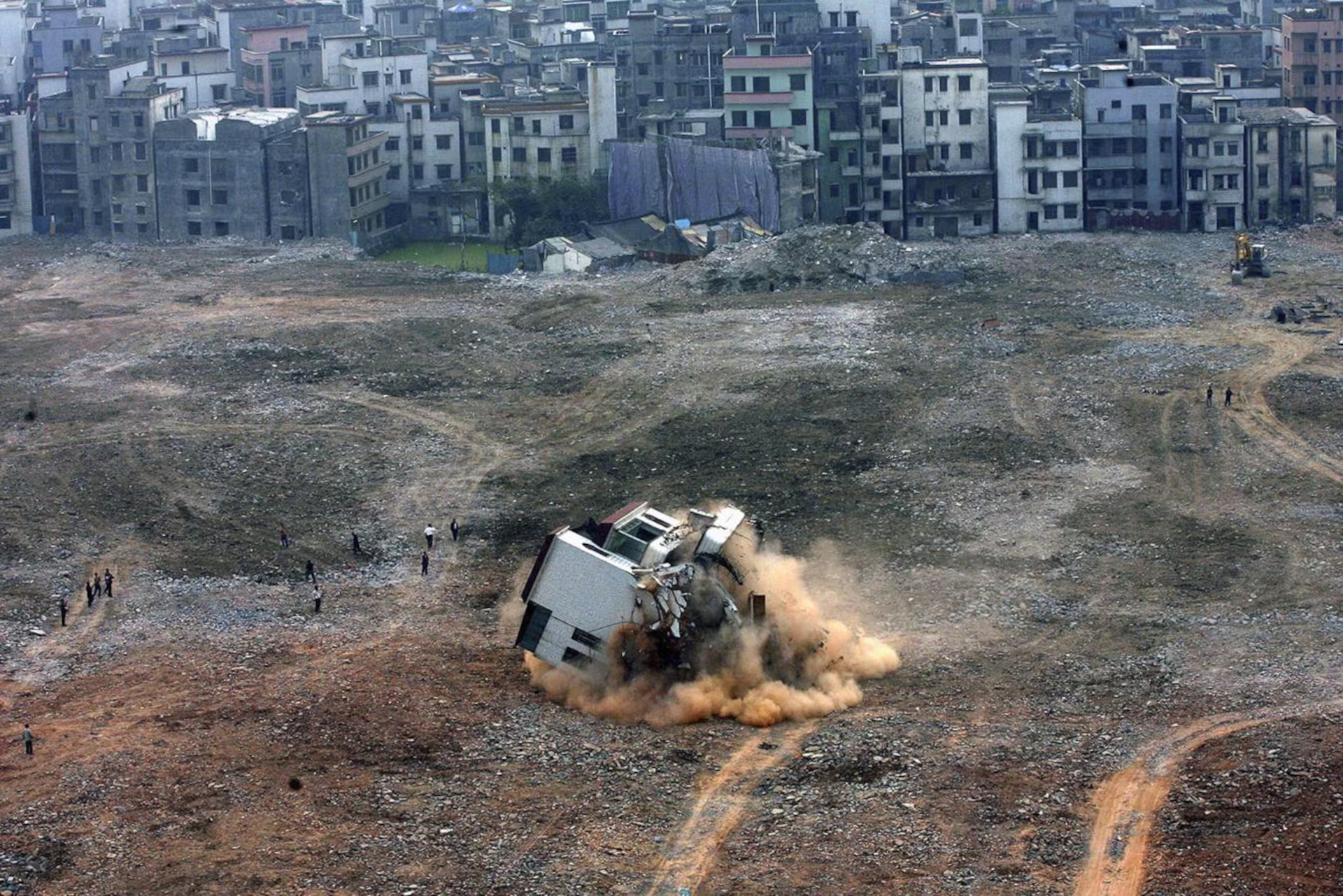
“How is the demolition going?” I cut in.
Father said he didn’t know, either, but everyone in the village was talking about it. He couldn’t imagine what he would do if the village was demolished. Where could he go?But he didn’t hide his happiness when he mentioned the rumored generous compensation. Then he looked at the door that Wang Yuan had just rushed out of.
Obviously, he was more interested in hearing about this woman than he was in talking about demolition. Demolition would greatly improve our family’s financial circumstances, but he assumed that Wang Yuan would be his daughter-in-law, and he’d like to be involved in making family decisions. I had been used to contradicting my father since my adolescence. To destroy his illusion once and for all, I proclaimed that this woman was a “chicken.”
“What? A chicken?” My father, who had lived in the village all his life, was unfamiliar with modern Chinese slang.
“A whore! She’s a whore.”
Even though I was kind of aware of my father’s ancient values and morals, I underestimated their power. Father was flushed with anger. He stood up indignantly and left abruptly. My father had come all the way to the city to see his son, only to sit there for less than half an hour and then go back without even having anything to eat or drink.
Later, my second aunt told me, when Father came home and saw that Zhang Fei had eaten all the food that was meant to last the whole day, he kicked it hard. Zhang Fei’s screaming startled my aunt who lived next door. She thought it was some thieves hurting the dog, so she and my uncle went over to check. Father said nothing to them, and he didn’t cook again that day. Aunt took him some food, and the next day, she saw that he hadn’t touched it. In other words, Father had eaten nothing all day.
I didn’t know until then that Father had something important to discuss with me when he came to see me that day: My second aunt had a niece who was a college graduate and worked in the city. She was still single in her thirties, possibly because she was fat. Aunt said, “There is nothing wrong with a girl being slightly overweight. A fat butt is a good butt for giving birth to a son.” She also said, twins ran in her family; if her niece married me, maybe she would give my father two grandsons at once. The girl was in her early thirties, and I was nearly forty—our ages made a proper match. Besides that, because my father would be given housing and cash after the village was demolished, we would no longer be poor. Aunt was sure the girl would agree to marry me. It looked like a predestined marriage, didn’t it? My father was overjoyed. Since his son had been looking for a wife for nearly twenty years without success, it was time for him to step in and solve the long-standing problem at a stroke.
Father said, “Can’t you see that? You’ll turn forty next year. You’re no longer young. Forty is middle age.”
Of course, all that mattered to my father was that his son “had somebody,” and he didn’t care if that “somebody” was my aunt’s fat niece or someone else. Wang Yuan’s nakedness probably constituted proof that I “had somebody” already. He wasn’t foolish enough to believe that Wang Yuan was a “chicken.” He just couldn’t communicate with his son properly, and he was very angry at me and angry at himself, and he took out his anger on poor Zhang Fei. That’s all.
Auntie showed me a photo of her fat niece. But it was a picture of her when she was a little girl. The photo was probably taken at the dinner table during the Chinese New Year when she was four or five years old. She had plump cheeks, flushed pink. She looked quite pleasant. I could see that she’d been fat since childhood.
“Would you like to meet?” Aunt asked me.
Glancing at my father sitting beside me with a solemn expression, I said agreeably, “Yes, whatever you say, Auntie.”
Later events, though, led me to never actually go through with this plan. I’ll talk about that in a moment. However, I did imagine myself on a blind date with the fat girl:
We certainly wouldn’t meet in the village. We’d adapt to current customs, choosing a chain café or a park with a café in it. That was the most popular place for a blind date. Over the past twenty years, I’d gone on numerous blind dates set up by friends, old classmates, and colleagues. They felt they had to find a wife for me. The main function of our social relationships is to mold you into someone like everyone else. Only then do people feel comfortable interacting with you. We can’t tolerate people who are different, just like a nation can’t tolerate so-called traitors.
Before long, Father fell ill. He was diagnosed with terminal cancer, and died quite soon. To be honest, I can’t say that I was greatly surprised or sad when I was told the diagnosis. As a son, I had to take him to the hospital for testing and treatment, and then attend to his needs. Before he died, I didn’t even think that I was about to lose my father—this most important part of my family—and become a forty-year-old orphan. I just felt fatigue from the beginning to the end, and then I felt pain. A person being tortured by illness with no cure, and then dying hopelessly—this whole process could only be described as “devastating and shocking.”
At first while he was sick, Father still kept emphasizing the importance of my having a wife. He was tortured alternately by illness and this unfulfilled wish. Later, he was only half-conscious. I just sat quietly at his bedside, waiting more for him to die than for him to wake up. When he died, he was all skin and bones. I didn’t weigh him on the scales, but from what I could see, he was no more than seventy pounds. For a while, I had wished my father was a religious man. Would it have been easier for him? But, like many other people, under the section of religious belief in our household register, it says “none,” and that was completely accurate. What a pity.
I didn’t hold a funeral for my father in the village. There was no band, no mourning ceremony, not even burning of paper money. I had my father burned in a crematorium and buried his urn in my mother’s grave. Aunt felt I was an unfilial son. She seemed angry and stopped mentioning her chubby niece. And so, I saved the two hundred yuan I would have spent on dinner. But soon, more information about the demolition led her to bring up this subject again. She wouldn’t let go of it. What she meant was that my father’s death was bad timing, because the compensation for the demolition was based on the number of people in one’s family. For me to get more compensation, the first thing I needed to do was marry her fat niece as soon as possible, and it would be even better if we had a baby ten months later.
Now this was no longer just a matter of two hundred yuan for a dinner. I was really scared. After taking care of my father’s affairs in the village, I never dared go back there. I still haven’t. I don’t even know whether my village home, where my mother, father, and the young me had once lived, is now overgrown by brush and infested by animals. The only thing I know is that my aunt and the villagers are still waiting for the demolition.
Finally, after turning forty this year, I got married. My wife is none other than Wang Yuan. It’s hard for me to explain that. Wang Yuan moved directly to my place after her divorce, but we had just been living together illegally. One day, she told me she wanted to marry me. My mind immediately flashed back to my father’s visit the year before. I remembered my father’s curiosity and probing about Wang Yuan, who he thought was his future daughter-in-law. I also remembered that after my father died, I gave Zhang Fei away, and I didn’t know whether it was now alive or dead, and whether it still remembered the kick it took for me. Anyway, I burst into tears. It seemed that my reflexes were several months behind, and only now was I shedding the tears that a son should have shed when his father died.