


Twice in recent days, I’ve posted stages in a developing idea about Dante’s Divine Comedy. The work is coming up on its 700th birthday, yet its impact seems greater than ever, and we have to ask why. My own answer appeared first, in different form, in Southwest Review. Now, we climb towards salvation, led on by William Blake’s depiction of a bizarre parade from Purgatory .
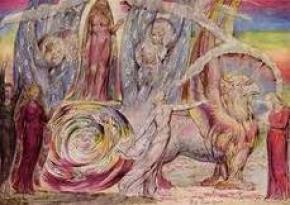

The closing of this canticle offers no small assortment of the strange. The phantasmagoric charade up in the Earthly Paradise, in Cantos XXIX, XXX, and XXXII, present Christianity as acid trip, the faith in hallucinatory allegory. That allegory only became clear about a century ago, thanks to exegesis by Charles Grandgent and others. Yet to unveil these systems of meaning reveals other subtleties. Consider the closing tercet-plus-one of the Purgatory — the sonic effect of the Italian.
When the Pilgrim turns at last towards the stelle, he’s just been baptized in the santissima waters of Eunoë (bathing in the River Lethe lets a soul into this Eden; bathing in Eunoë enables the ascent to the stars). He’s made new, “refreshed like a newly-leafed plant,” in a fugue of assonance and consonance:
Io ritornai da la santissima onda
rifatto sì come piante novelle
rinovellate di novella frondaPuro e disposto a salire le stelle.
No English translation captures the nuance. Anticipating the games that Vladimir Nabokov played with the name of his imaginary child-lover, in the first lines of Lolita, 

Our Pilgrim spends much of the two final cantos of Purgatory meditating on that Tree. Already a “miracle of height” (XXXII) it goes through miraculous changes at the hands of Beatrice and her angels. Though the protagonist understands this mountaintop is Eden, he first spies the tree “stripped of leaf and fruit.” Later, like his own revived soul at canticle’s end, the tree erupts magically into bloom at a touch of the “pole” that is Christ’s cross and faith. Still from its first leafless appearance this Tree is identified, in the original, as “una pianta.”
Now, surrounding this tree on the peak, just as down in the meadowlands at Purgatory’s foot, one finds a number of other trees, all unremarkable. In the canticle’s first episodes, they offer simple shade, as souls rest in preparation for the climb. 

All this presents a distinct contrast to the outstanding “plant” up beyond the Lethe, the tallest tree on the peak and the one honored with a chanting circle-dance by Beatrice, her angels, and a monstrous but gentle menagerie. Despite such company, Eden’s tree at first suggests Nimrod’s and Lucifer’s towers: an immense yet barren upright, silent and “stripped.” Dante could hardly have conveyed something more different from the rest of the Earthly Paradise, that “heavenly forest thick with living green” (XXVII), or from the trees down the mountain. This one stands as a naked totem for Original Sin, a root genus.
Immediately following this mute allegory of the Fall, the pianta goes on to represent the Resurrection. 

Such relations across the canticles glitter, impossible to miss even in the most obscure passages, such when Beatrice speaks in riddles, numerological riddles, in her final prophesy. Arcana like that could’ve overwhelmed the work, reducing the Comedy to The Da Vinci Code. Dante however provides consistent relief from the abstruse via the anchoring figure of the Tree. Beatrice herself simplifies matters by reference to the “pianta.” She tells her guest that when he describes these visions,
…be sure you that describe
the sad condition of the tree you saw
despoiled, not once but twice… (XXXIII)
The lines express outrage over the corrupt 13th-Century church, to be sure. Yet before a thing can be polluted, it must have been pure, and the true power of Purgatorio’s finale derives not from angry invective that requires a footnote, but from pleasure as universal as a day in the park. 
