

And so the journey is finally over. Begun in the snowy December of 1933 by a young man not yet turned 19, and completed now, two years after his death at the age of 96. Or not quite completed; the main narrative ends half way through a sentence, to be followed by a handful of diary entries, and then by pages from a much longer, much more discursive journal. But it is an ending of a sort, and after so long, so frustrating a wait, it is more than welcome.
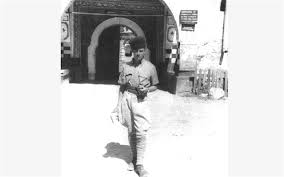
He did, indeed, walk practically all of the way, though his rather romantic notion of sleeping in barns or out under the trees didn’t quite work out as planned. He started out with various letters of introduction, and these, plus happenstance, brought him into the sphere of some of the great families of Europe before this extravagant aristocracy was overthrown by the coming turmoils. Before too long he was spending time in castles and great country houses, and being passed along from one landed aristocrat to another. To be fair, he seems to have earned his welcome; by all accounts (not least his own) he was convivial, presentable, ever eager to stay up all night drinking and singing, and always eager to hear the stories his hosts had to tell. It is also fair to say that he did, indeed, beg hospitality off peasant families, stay in small inns, and on occasion sleep in barns, but it was, all told, a rather grand tour.

Of course, the book didn’t happen, at least not as intended. His first notebook was stolen in Germany. Later notebooks were sent to England for safe keeping, where they were lost. After reaching Constantinople, which seems to have signally failed to impress him, Fermor went on to Mount Athos, then to Greece, then back to Romania where he lived for the next few years with Princess Balasha Cantacuzene. Then the war intervened, Fermor became an SOE officer in Crete, famously kidnapping General Kreipe (an incident made into a film, Ill Met By Moonlight, in which Fermor was played by Dirk Bogarde). After the war he led a fairly peripatetic existence, eventually starting to write in the 1950s with a travel book and a novel both set in the Caribbean, and finally settling in Greece. Then, in the 1960s, Holiday magazine commissioned him to write a 5,000 word article about walking, and he started to write a piece called ‘A Youthful Journey’.

And then we waited. A Time of Gifts and Between the Woods and the Water had been instantly recognised as masterpieces, this was clearly one of the finest works of travel literature ever written. We were eager for the conclusion, but it did not come. Always a slow, painstaking writer, the despair of his publishers (every manuscript he ever delivered was late, sometimes by years), now the weight of expectation seemed to have turned slowness into inertia. His publisher died in 1993, his wife in 2003, and it began to seem that the great work would never be finished. But, in fact, the 60s manuscript of ‘A Youthful Journey’ had been rediscovered, along with one of the long-lost diaries from the latter part of his walk, and over the last years of his life Fermor had been revising and drafting and redrafting the thing. It was unfinished at his death in 2011, but much of it was there; in fact there were several very different drafts, which his literary executors, Colin Thubron and Artemis Cooper, have turned into the book that has now been published. The main narrative ends, mid-sentence, on the Black Sea coast of Bulgaria, still some days walk away from Constantinople, but Thubron and Cooper have added some of the brief diary entries that cover his few days in the city in January 1935, followed by the far more extensive journal entries that report his month-long stay on Mount Athos during that January and February. It is not, perhaps, the finished book that Fermor would have wanted, but it is close.
The Slav liturgy of vespers boomed out by a score of black-clad and long-haired and long-bearded monks, all leaning or standing in their miserere stalls, sounded marvellous. It continued for hours. Afterwards, charitably singled out as a foreigner, I was given a little cell to myself, although the monastery was so full that villagers were sleeping out with their bundles all over the yard and under the trees. Many more arrived next day and the inside of the church virtually seized up with the pious multitude. There were an archbishop and several bishops and archimandrates besides the abbot and his retinue. They officiated in copes as stiff and brilliant as beetles’ wings, and the higher clergy, coiffed with globular gold mitres the size of pumpkins and glistening with gems, leaned on croziers topped with twin coiling snakes. They evolved and chanted in aromatic clouds of smoke diagonally pierced by sun shafts. When all was over, a compact crocodile of votaries shuffled its way round the church to kiss St Ivan’s ikon and his thaumaturgic hand, black now as a briar root, inside its jewelled reliquary.
This is so typical of Fermor. The long, sinuous sentences, brilliantly studded with sensuous descriptions and knotted with the long specialist words he so loves (archimandrates, thaumaturgic). You lose yourself in Fermor’s prose, emerging for air every so often to realise, at exactly the same moment, that you have an incredibly vivid image of the colours and smells and shapes of things and no real idea of what is actually going on. But then, he was a callow youth with at best a shaky understanding of the language, so what he conveys in the prose is pretty much the experience he must have had.

And yet, as you lose yourself in the convoluted sentences, or reach wearily for the Dictionary once more to identify an obscure word (lorica, arhondaris, epitropes), or find yourself briefly jarred out of the narrative, you are still relishing every word, still loving the words pictures he paints so lavishly. And what pictures: it is a world closer to the 19th century than our world, a place of ramshackled timber buildings, of people still wearing Turkish costumes, of instinctive hospitality, of Turkish and Greek and Jewish and Moldavian and Russian communities living uneasily next to each other. Within five years, most of this would be swept away, first by the Nazis and then by the Communists. We couldn’t see any of this now, except through Fermor’s eyes. It is a broken road indeed, but it is still a glorious and enchanting road.
And after so long, what a pleasure it is finally to join him on the last stretch of his Grand Trudge!