

In the pedestrian precinct outside Debenhams there is a small white hat, the sort of thing that might be made for a tiny baby or possibly a doll. It is rumpled and slightly discoloured, you imagine the child who lost it, or the distracted parent who put it down and forgot to pick it up again.

Just around the corner from Tracey Emin’s hat, an old tree stands in the middle of a traffic island. It stands as tall as the three storey buildings around it, though it appears slightly unbalanced since a lightning strike tore off one of its limbs a couple of years ago. The tree is a London Plane, which is actually a hybrid of two trees, one from China and one from America, that crossed in Lambeth sometime in the 1600s. We learn this from a small blue plaque on a low wall just across the road. The plaque looks like the sort of thing a particularly inventive Council might erect, and there is nothing about it to say otherwise, but it is in fact another survival from the 2008 Triennial. ‘Racinated’ by Richard Wentworth consists of ten such plaques dotted around the town, we are introduced to hornbeam and whitebeam outside a branch of Santander and white poplar at the top of the cliff. The trees thus described are all non-native species, and the installation thus calls attention to the importance of immigrants to how we view the country today. It is an interesting idea, if not always immediately obvious in what these plaques tell us.
The Folkestone Triennial was launched, with much fanfare, as a festival of modern art that would attract visitors to the town, but also benefit the town by leaving behind public art on permanent display. In the first part of that it has succeeded very well, drawing in a steady stream of visitors during the heady summer days when the festival actually runs. To judge how well it has succeeded in the latter aim it is perhaps worth seeing the public art in place during the grey, unseasonal days of winter.
Emin’s ‘Baby Things’ and Wentworth’s ‘Racinated’ were two of the eight artworks that have remained on public display since the first Triennial, although a couple may be stretching the definition of public art somewhat. If art consists not just of a picture but of its frame, the context, the setting in which we observe it, then public art is defined by the way it is presented within the open spaces, by the way it informs and is informed by those spaces. In which case, the public art that Folkestone has inherited from the first Triennial tells a sad story, a story exemplified by the abandonment inherent in Tracey Emin’s work, by the broken tree that Wentworth’s piece now happens to indicate.
The public part of Adam Chodzko’s ‘Pyramid’ is now pretty much limited to a noticeboard affixed at the foot of the cliff below the Leas Cliff Hall. The notice tells a ludicrous story: ‘A rumour grew in Folkestone that the town’s misfortunes were caused by the four inverted pyramids that support the overhang of the Leas Cliff Hall.’ There has, of course, never been such a rumour, but the construction of a myth to make us see a story in the happenstance of pre-existing industrial design is an intriguing way of presenting our relationship with our built environment, even if not entirely successful in this case. Nothing in the environment has been changed to give flesh to this bald story. Physically, the inverted pyramids remain; psychically, the town remains misfortunate. Something more than a statement on a noticeboard is needed to turn an idea for an artwork into actual art. Of course, Chodzko provided more, there is a video installation, not that you would know it from the noticeboard, and not that you can actually view it since the Visitor Centre where it is supposedly on display appears to be not only closed but stripped of all content. It makes the notion of public art particularly problematic if a vital element in the piece is not actually available.


All of these examples of public art, whether intentionally or not, whether it is inherent in the artwork or its position or simply changing circumstances, seem to suggest the run down, the lost, the abandoned. It is an attitude perhaps best summed up in the last of eight pieces. Devised by Nathan Coley, it consists of lights set up on the roof of what was once the post office but what is now the heart of the grandly-named Creative Quarter, the lights spelling out: ‘Heaven Is A Place Where Nothing Ever Happens’. It is a sentiment that seems to speak for all that has survived from the 2008 Triennial.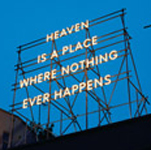
The public art that is Folkestone’s legacy from the festival of modern art that is the Triennial seems to raise questions about: what is public? And: what is art? And, perhaps most pertinently: what endures?