

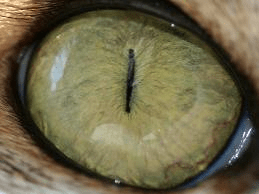
“An animal looks at me. What should I think of this sentence?”
–Jacques Derrida
In today’s print issue of the New York Times, there’s an article called “Animal Studies Cross Campus to Lecture Hall.” According to Marc Bekoff, an emeritus professor of ecology and evolutionary biology at the University of Colorado, the emergent field of “animal studies” encompasses “anything that has to do with the way humans and animals interact.” Reading the article made me think back to a debate I had last spring with a former colleague about the validity and value of animal studies. My colleague had thought that animal studies was bogus interdisciplinarity, a distraction from the pure pursuit of literary learning while I was trying to entertain notions of how animal studies could enrich our reading and understanding of literature. I had followed up my comments to him with an informal email that included a reading of Rilke’s famous poem “Black Cat.” This is the poem (in Stephen Mitchell’s translation) from the marvelous book New Poems:
A ghost, though invisible, still is like a place
your sight can knock on, echoing; but here
within this thick black pelt, your strongest gaze
will be absorbed and utterly disappear:just as a raving madman, when nothing else
can ease him, charges into his dark night
howling, pounds on the padded wall, and feels
the rage being taken in and pacified.She seems to hide all looks that have ever fallen
into her, so that, like an audience,
she can look them over, menacing and sullen,
and curl to sleep with them. But all at onceas if awakened, she turns her face to yours;
and with a shock, you see yourself, tiny,
inside the golden amber of her eyeballs
suspended, like a prehistoric fly.
And here is what I wrote about the last stanza:
I’m just wondering out loud here now but isn’t this ending as much about interspecies awareness as it is about specularity and metaphor? Or can we say something productive of the fact that the human, the insect, and the feline are being triangulated by what Richards calls the tenor, vehicle, and ground? Here it seems like this epiphanic “shock” is more than what Barbara Herrnstein Smith is calling the “ontological thrill of the animal” (the term is from her book Scandalous Knowledge: Science, Truth and the Human)– it’s about the awareness of another being (a prehistoric fly) by way of a defamiliarized (or rather figured or metaphorized) reflection of the self. And it is an “awakening” of sorts of the “you” by way of an imagined awakening of the cat (“as if awakened”). It seems to me that this epiphany (if we can borrow from Joyce) or this “spot of time” (if we can borrow from Wordsworth) is all about imagining the human as a speck (like the insect) within the long continuum of geologic time; one might call this the “prehistorical sublime.” I am not quite sure what “animal studies” actually is but I would like to imagine that its horizon can be amenable to and enrich the cursory analysis that I’m trying to do here… any thoughts?
My colleague declined to answer, but I was wondering what you all think about what is not quite a field, a field that is in its “prehistoric” state. Looking back at the Rilke passage again I’m struck how the cat becomes almost a “fossil record” of gazes–the cat as a wondrously absorptive archive of pelt, a languorous and infinite repository for one: “She seems to hide all looks that have ever fallen / into her, so that, like an audience, / she can look them over, menacing and sullen, / and curl to sleep with them.”