


Three times, recently, I’ve posted my ideas about Dante’s Divine Comedy. I’m exploring why a long poem coming up on its 700th birthday, one with a form and a theology that few people care about any longer, should have such enormous contemporary impact. The earlier stages of my investigation are here, here, and here, and again I have to thank Southwest Review, where these ideas appeared in a different form. Now, Paradise, with a sketch from Sandro Botticelli to begin with.


The Comedy’s last canticle demands a move away from the familiar. The realm of the Blest must come across as something else again, and it does, with glowing cross-galaxy swoops and landings that suggest computer animation, centuries ahead of its time. But then the subject has no truck with time; it exists outside time. Nor should anybody confuse actual Paradise with its faint simulacrum, the Earthly Paradise. The flowers and waters of the Empyrean, in the final cantos, recall the peak of Purgatory, but they’ve gone unearthly.


In Italian, the discovery resounds with the r and v of primavera, and the rolling of the lips may suggest flowers bursting at springtime. But in any language this foretaste of the Divine tastes strange:
And I saw light that was a flowing stream,
blazing in splendid sparks between two banks
painted by spring in miracles of color.Out of this spring the sparks of living light
were shooting up and settling on the flowers:
they looked like rubies set in rings of gold.
Miracle builds on miracle: sentient glimmers leap onto starflowers that turn to heirlooms. Meanwhile there’s allusion to both the Old Testament (Daniel’s “stream of

Also the crossing enacts a miracle within the point of view — a part of that mad experiment which distinguishes Paradise. Here again, the Dante character again understands something beyond ordinary understanding. The traveler has managed to “transhumanize” — as Musa renders trasumanar, the remarkable neologism from Paradiso’s first canto. Simply to enter Paradise, the Pilgrim needs to transcend to a fresh level of apprehension. 30 Cantos further up, on the verge of his greatest epiphany, he needs to acquire his fullest powers of perception. Therefore he undergoes a “transhuman” baptism, going beyond the earlier cleansings in Lethe and Eunoë.
Such constant heightening of consciousness presents an extraordinary artistic challenge. Yet Dante the poet, as opposed to his creation the Pilgrim, understands that the art of the last canticle mustn’t violate the drama of Inferno and Purgatory. The experience, however epic, must retain aspects of human scale. Thus a concluding image of Paradise, in dialogue with the two earlier ones I’ve looked at, sets forth a fundamental human concern, a psychological essence.

What’s most resonant about the Paradise image resides in the Italian word “lume.” This occurs in the first line quoted above, and the most precise translation isn’t “light” in the standard sense. That’s the English preferred by most translators, “light,” though the correct Italian in that case would be luce. Lume, which occurs a number of times during the closing cantos, connotes a relative weakness, an evanescence, as in the expression a lume di candela, by candlelight.
Dante’s reliance on lume can’t be put down, simply, to the technology of his time. He

Once the Pilgrim’s candle has been dipped into its stream of flame, his first impressions of highest Heaven beyond are full of biplay between the all-powerful luce and the more confined and temporary lume. In XXXI we have the “luce divina” and other direct references to elements of God. But the Pilgrim sees the faces of the Blest as “d’altrui lume fregiati,” “adorned in borrowed light.”

Scholars have noted the pervading use of reflection and refraction. The way Singleton puts it, the newcomer to the Celestial Rose discovers he’s “been seeing by reflected light all the while.” Such a process makes a natural correlation with the Pilgrim’s need to transhumanize; he approaches the Divine via a series of smaller-scale models. So too, in the final tercets of Paradise, the supreme illumination of the Godhead makes a place for its flickering domestic stand-in.
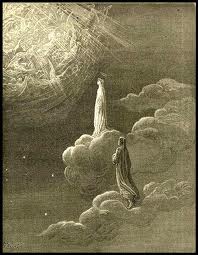

At the close of the Comedy, the recurrent opposition of sunlight and candlelight creates dramatic tension, a counterpoint that nags at revelations.

The quiet lapping of luce and lume works against inflated rhetoric about the Omnipotent. Had our narrator gone for more stentorian affect, like an Italian Isaiah, we would’ve come to a briar patch rather than a rose, a place that would brook no transhumanizing. But Dante plays up the quieter 
