



Having spotted this trend in the genre, I started to notice analogous changes elsewhere: the role of religion in American politics and more recently in British politics; the increase in the number of faith schools; more strident demands that groups be allowed to institutionalize prejudice against women, gays, others because it is sanctioned by their religious beliefs. And on and on and on. Traditional religious behaviour, such as church going, may still be in decline (I haven’t seen any recent figures one way or the other), but religion, or let’s be more general, belief systems, seem to be playing a more prominent part in social, policy and behavioural matters.
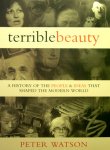
Watson’s book doesn’t address any of these matters directly. But as you read through you begin to get a sense of the rational part of human thought, science and its adjuncts, appearing increasingly less rational. Just look at the most significant developments in one area of science over the century: relativity, quantum physics, uncertainty, chaos, complexity. By the time we get to things like string theory, then, as Watson puts it, the metaphors break down: what is being understood in cosmological terms cannot be explained in comprehensible terms, only using a form of mathematics that many mathematicians find difficult. And in mathematics we get things like Godel’s Incompleteness Theorem which demonstrates that there are mathematical truths that cannot be proved by maths. Alongside this, analytical philosophy began the century in a positivist vein, but by mid-century had rejected positivism. Karl Popper argued that scientific theories cannot be conclusively proven, only falsified. It is a sensible approach to the business of experimentation, but to anyone not versed in such things the more or less coincident arguments of Godel and Popper together suggest that there is no such thing as scientific truth. And later theorists have gone even further along this route, it is now common (though this doesn’t make it into Watson’s book) to view scientific theory as a narrative, and like all narratives it is open to external influences such as the character of the narrator. If you are affronted, frightened, disturbed or merely uncertain about the findings of science, it is getting easier to dismiss them.
And if science has led us away from confidence, then what about European strands of philosophy that have led, from Kant and Hegel and Marx to existentialism, deconstruction, and the works of Foucault, Derrida and their like, as difficult for the layman to understand in their way as string theory is. In literature the old realist notions that the world can be described have been undermined by modernism with its Freudian emphasis on the uncertainty of the individual and then by postmodernism which adds to the mix an uncertainty in the provenance of the world.
The public intellectual has become a university specialist, because the workings of science, philosophy, economics, sociology, even literature have become so abstruse that they can only be comprehended by concentration on their complexities to the exclusion of all else.
Of course, for every specialist there is another specialist who is going to disagree. That is a necessary part of the academic process, it is how ideas are tested. But if the ideas are not accessible in the first place then all that can be seen is squabbling on some esoteric plain, angels fighting on the head of a pin. Absolutism and confidence are out, relativism and uncertainty are in. Of course, if you are engaged in the project, whether it be science or literature or what have you, then such relativism can be exciting. But if you are not engaged in the project, it is undermining, confusing. Is it any wonder that people turn to the old and reassuring sources of confidence, the belief systems where truth is an absolute not some slippery relative term?
The reason Watson gives for the relatively small part that the African, Islamic, Hindu and Chinese worlds play in his story is that during the twentieth century the main intellectual endeavour in these realms was directed towards the defence of their older systems of thought from the undermining effects of Western modernism. To be honest I find this far too glib and partial a perception to be anything like the whole truth; in the world of ideas covered by this book I suspect that much work was and remains simply unseen in the West. Nevertheless, if it is even a partial truth we can see reflected in it the rise of fundamentalism (both Islamic and Christian) as a reaction against the unsettling notions of the modern world, and a return to simpler, more reliable, more absolutist ideas.
Which has taken me some way from my perceptions about the role of God in current science fiction, but since I believe science fiction is a good way of gauging the concerns of popular culture, it is all part of the same thing.