

After college, a friend and I went on a tear, spending our weekends watching everything we could find by Godard, Bergman, Tarkovsky, Kurosawa, others. My friend’s father, a former cinephile who’d seen many of these movies during their initial US releases, occasionally poked his head into the living room, watching a few minutes here and there with us. Then he’d smile and leave, always quietly pronouncing, “It’s good, but it’s no Two-Lane Blacktop.”


Two-Lane Blacktop, briefly put, is an abstractly artistic car race movie directed by Monte Hellman, a friend of Jack Nicholson’s. Like Nicholson, he spent the 1960s working for Roger Corman, making quickie horror, Western, and war films such as The Terror, Flight to Fury, Back Door to Hell, Ride in the Whirlwind, and The Shooting.
After the surprising popularity of Easy Rider, producers were desperate to repeat that film’s success. (The 60s had seen studio films grow increasingly unpopular with younger audiences.) Hellman was given the Two-Lane script by producer Michael Laughlin, and funding and distribution by Lew Wasserman “youth unit” at Universal. He liked the basic concept—two guys drive cross-country, accompanied by a young female hitchhiker—but hated the actual script, so he convinced experimental novelist Rudy Wurlitzer to completely rewrite it:
MH: The script that I was given bears no resemblance to the movie. Rudy Wurlitzer had not yet been involved — it was a Will Corry script that had been bought by, not Universal but by another studio, for producer Michael Laughlin. He asked me to direct it, and I said that I would, because I liked the basic idea of it, but I said I would only do it if I could hire somebody else to do a new screenplay. And he agreed and we found Rudy, and I worked alongside him while he was developing the script. It was exactly the movie that I wanted to make, and I was really excited to be working on it.
The two of them then proceeded to make a movie unlike any other in US film history.
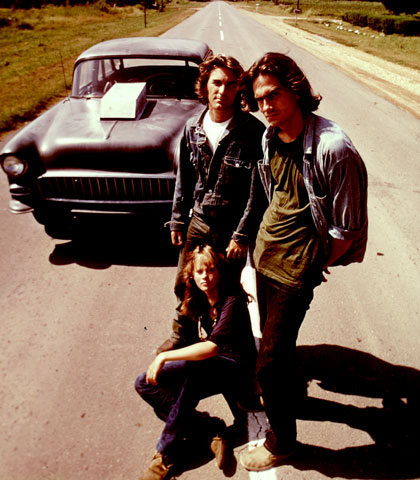

One of the more intriguing aspects of Two-Lane Blacktop is its casting. There are four leads, three of which (the script’s original three youngsters) are played by non-actors:
“The Driver”: James Taylor: Yes, that James Taylor—

—although back then he was more like this James Taylor:

(Well, he was younger, at least—and cuter!)
Two-Lane Blacktop was Taylor’s only feature film appearance; Hellman tested and cast him after seeing him on a billboard. Hellman supposedly originally wanted veteran character actor Bruce Dern for the part, but Dern instead appeared in Jack Nicholson’s adaptation of Drive, He Said. Hellman also asked Kris Kristofferson, who was about to make his film debut in a small role in Dennis Hopper’s The Last Movie. Both The Last Movie and Two-Lane use Kristofferson’s then-new self-recording of “Me and Bobby McGee”:

“The Mechanic”: Dennis Wilson: Yes, that Dennis Wilson, also making his only big-screen appearance.


“The Girl”: Laurie Bird: A relatively unknown model at the time, she went on to act in only two more films: Hellman’s 1974 feature Cockfighter, and Annie Hall, where she played the girlfriend of Tony Lacey (Paul Simon). That last role was something of an in-joke; in reality, she was Art Garfunkel’s girlfriend. She killed herself in 1979, while Garfunkel was off making Bad Timing.


To this already offbeat mix, Rudy Wurlitzer added another character, a middle-aged man driving a Pontiac GTO. Hellman cast his friend Warren Oates (who’d been in The Shooting), then probably best-known for his supporting turn in Sam Peckinpah’s The Wild Bunch.


(That trailer features too little Oates; look for him at 2:13.)


Wurlitzer rewrote the plot, turning it into a race between the three youngsters in a homegrown, souped-up Chevy, and a representative of the older establishment, driving a luxuriously decadent Detroit muscle car. Yet, despite how some critics read the film at the time, neither Wurlitzer nor Hellman were interested in a straightforward metaphorical commentary on late 60s society.
Indeed, what makes the film so indelible—and so unclassifiable—is its synthesis of at least four different approaches to filmmaking:
1. Regionalism
Hellman took the production cross-country, shooting the entire film on location. Many scenes pay focused attention to regional detail, such as the one in which Laurie Bird panhandles in Santa Fe (which plays like a missing shot from Barbara Loden’s Wanda). The soundtrack, while sparse, remains distinctly American, consisting of “rock, soul, hillbilly, [and] Western” tunes like Chuck Berry’s “Maybelline” and Arlo Guthrie’s “Stealin.'”


(Neither James Taylor nor Dennis Wilson sing in the film, and none of their music is used. Laurie Bird, anticipating Cat Power, does sing a few mumbly phrases of “Satisfaction.”)
2. Existentialism
Hellman has admitted to the influence of Sartre and Camus. Two-Lane Blacktop also demonstrates a strong awareness of European art cinema of the 60s:
a) the French New Wave—think of the open ending of The 400 Blows, and Godard’s tendency to interrupt his plots with long, digressive scenes:

b) …the metatextual experimentation of Bergman’s Persona:

c) …Michelangelo Antonioni‘s fascination with the immensity of the landscape:


d) …and Robert Bresson‘s asceticism, especially his fondness for working with non-actors, and removing all traces of theatricality from their performances:

And yet Two-Lane Blacktop is not a European art film. Like its contemporary Point Blank, it freely borrows concepts and design elements, but it adapts them to the more goal-oriented structure of a Hollywood film.
3. The Car Race / Road Movie Genre
Two-Lane meanders and digresses, but it remains at its core a road movie. I disagree with those who call it “a film about car-racing that features no real racing segments”: while it isn’t Vanishing Point, it features four races, and opens and closes with them:

(Interestingly, Hellman has said he approached the film not as a car race movie, but as “a gambling movie.”)
That said, Two-Lane also takes care to include many of the things that race movies don’t include, such as getting in and out of cars (repeatedly), sitting in cars but not driving, stopping to go to the bathroom, stopping for the sake of stopping, …. And while I disagree with Roger Ebert‘s reductive, overly metaphorical reading of the film, he’s quite right when he describes the film’s race as:
an odd race in that nobody much seems to want to win. The driver and the mechanic have devoted their lives to racing and winning with their customized and rebuilt Chevy, and G.T.O. identifies intimately with his car, yet they keep stopping to help each other along the road, as if the road would be unbearably lonely if that other car weren’t sometimes in view.
At one point, after a particularly leisurely digression, GTO angrily shouts at the others, “Are we still racing, or what?”
4. Postmodernism
(I’m going to pretend for now that postmodernism exists—or, at least, that such a thing as a postmodernist aesthetic exists.) At its heart, the postmodernist aesthetic is concerned with conflating genre conventions, and with exposing the artifice of the artistic product. Hellman repeatedly collides the scruffy, taciturn non-actors in the Chevy with the polished, verbose Warren Oates. (That these actors are able to function together so wonderfully is a testament to the skill of everyone involved.)
Because of these conflicting interactions (both between characters and types of scenes), Two-Lane, in addition to whatever else it is, it is a meditation on identity—both its fluidity and its absence. The Driver drives; the Mechanic is a mechanic. GTO drives a GTO. In another possible nod to Persona, Oates’s character’s origin story changes (just like the color of his cashmere sweater) with every hitchhiker he picks up:


As he himself puts it, in a moment of unwitting candor: “You ought to see what I’ve been picking up off the road. One fantasy after another.”
By the film’s end, GTO has adopted the composite fantasy of the Driver and the Mechanic, leading to one the picture’s most beguiling passages:
GTO [describing his car]: I won it flat out. I was driving a ’55 stock Chevy across the country and got into a race with this GTO for pink slips. I beat the GTO by three hours. Of course the guys in the GTO couldn’t drive worth a damn. But I’ll tell ya, there’s nothin’ like building up an old automobile from scratch and wiping out one of these Detroit machines. That gives you a set of emotions that stay with you. You know what I mean? Those satisfactions are permanent.
Transcendence
GTO is right, after a fashion: Two-Lane Blacktop is a very satisfying film. While not wholly a car race movie or an existential European art film, Two-Lane satisfies. Ultimately, Hellman and Wurlitzer and company found points of intersection between all of these genres of filmmaking, and their different styles and approaches, crafting a work that is simultaneously a realist film, an artificial genre film, an experimental film, an American film, and a European film.
Which is precisely what makes it so great. Rather than be beholden to any one approach, Two-Lane takes what it wants and needs from its four founts of inspiration—but only what it wants and needs at any given moment.
Ultimately, Two-Lane Blacktop is wholly itself.