


What is innovation in art? This is something I’ve circled in my other posts, for example:
- “Notes on Twee, part 2: The Crash Test Dummies”;
- “Experimental Fiction as Genre and as Principle”‘;
- “Art’s Morality.”
Now I’ll try addressing it a little more head-on.
All art contains both innovation (unfamiliarity) and convention (familiarity). Some artworks are so familiar as to preexist themselves. I didn’t like Andrzej Wajda’s recent film Katyn (2007), thinking it nothing more than a string of war movie clichés (this time in Polish). Its being unoriginal and predictable annoyed me; I might have walked out (or fallen asleep) had I not gone to see it with a couple of friends (who for the record both really liked it). And I felt as though its unoriginality trivialized its very serious subject matter, the Katyn Massacre.
On the other hand, some artworks are so radically different from what we know and expect that we can’t make any sense of them, let alone recognize them as artworks:
efwuhfieurbcriucnbicuiu
fuifhiuhf34iu
fh13u4hfiu4hf4iuhf
\
…How do you like my new poem? Oh, you like it? You’re determined to consider it a poem? I suppose it’s visual poetry, and I suppose we could consider any writing poetry, if we tried hard enough. Or read it aloud: it’s transcribed sound poetry!
Well, then, how do you like this new poem?

…It’s from my new poetry manuscript, Photos of Celebrities I’ve Downloaded, which consists of photos of celebrities I’ve downloaded. Here’s another poem from that collection:

You and I, being innovative and sophisticated artists, could probably find ways to approach these photographs as poems. But we could also keep playing this game, imagining things that are less and less poem-like. Eventually we will find something that even you, my dear innovative reader, won’t be so quick to consider poetry…
So even though an innovative artwork is unfamiliar, it must also (like all artworks) be somehow familiar. The innovative poem must still be poem-like, to some extent. If I were to ask you to describe poetry to me, you’d probably do so in some relatively agreed-upon, recognizable way: “Language that plays with itself, that often describes things but not in too straightforward a way. Sometimes it uses preexisting forms and certain prosodic conventions like meter, alliteration (but not always). Some well-known poets include Emily Dickinson, Lorine Niedecker, Sylvia Plath, and Lyn Hejinian.”

You probably wouldn’t say, “Oh, poetry, it’s a kind of gas, but not the kind you can breathe if you want to get a raise. It exists only in deepest outer space, where it’s covered with melted Swiss cheese. Some well-known poets include Neil Patrick Harris, Martina Navratilova, and that Japanese trumpet-playing robot.”
…Well, you might say that, but good luck finding others who’d agree.
Who’d really agree.
Meanwhile, the things that we find familiar and unfamiliar are ever-changing—and not in some kind of linear progression. We recognize the 2000s as having been different than the 1990s, and from the 1980s—hair styles have changed over the past few decades. Clothing styles go in and out of fashion. But I don’t think we’d argue that these changes are evolving toward something strictly better—although some of us might prefer the current styles to previous ones, or the opposite. And we recognize how certain styles from the 1970s have “returned”—albeit differently.
Innovation in the arts works similarly. Certain things—strategies, subjects, forms, devices, tropes—come into and go out of fashion. When everyone around you is doing one thing, you can’t also do it and be innovative. Some things are consistently popular; other things are rarely popular. Sometimes it’s surprising, though, what becomes popular!

(Money helps.)
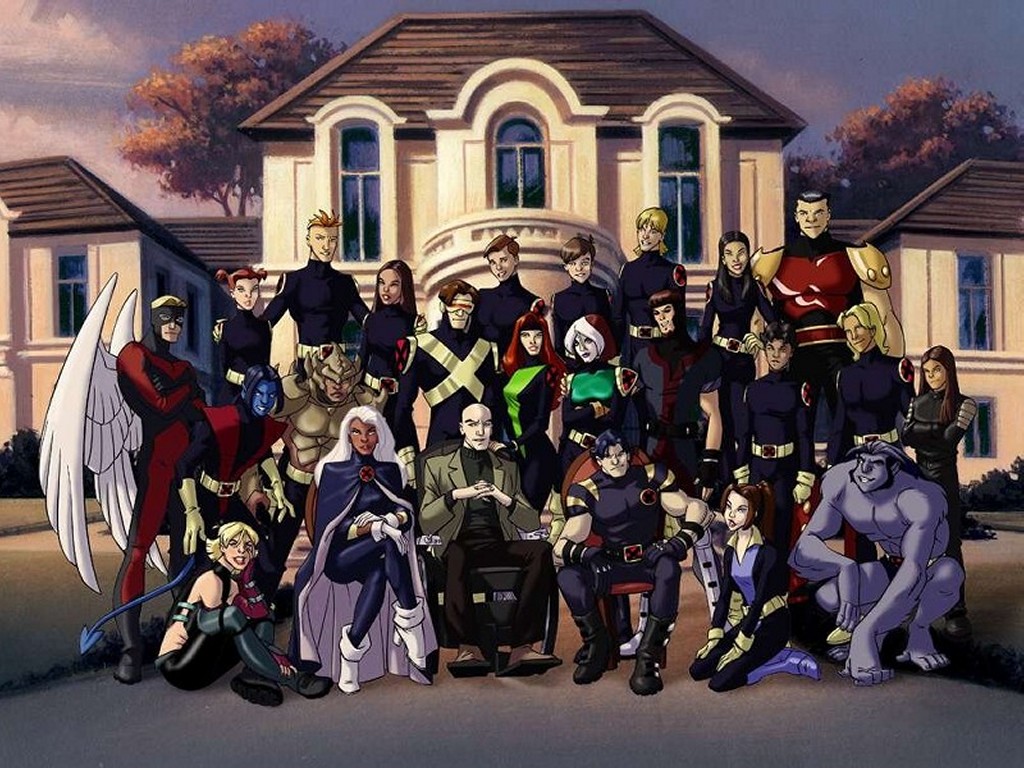
Nor is innovation limited to the experimental or the avant-garde (and who ever said it was? well, some people claim it is—whence it trickles down to the middle class like wealth did under Reagan). To pick an obvious example, part of J.K. Rowling’s success stems from her having resurrected the boarding school story. These stories were common in England and France in the 19th century and early 20th century, comprising their own genre, but they faded from prominence after World War I. Rowling brought the genre back—but differently. And now such stories are common again. Look at how the X-Men franchise, for instance, became more about Professor Xavier’s School for Gifted Youngsters in the wake of Harry Potter:
At the same time, even the avant-garde can become very familiar, to the point where it is no longer innovative. Scratching on film is not a new idea; it’s old-hat in experimental film circles. Stan Brakhage and Len Lye explored it extensively in works that are now canonical experimental films:
1955, Reflections on Black by Stan Brakhage:

Brakhage was among the first filmmakers to physically alter the filmstrip itself for metaphorical effect. The most striking example of this technique in his early films occurs in Reflections on Black (1955), which imagines the dream-vision of a blind man as he walks through a city, climbs the stairs of his apartment building and arrives home. Brakhage signals the blindness of his protagonist by physically scratching out his eyes, and splices in bits of film negative to convey the sense of experience the world as a blind man might, not as something seen, but something pictured. —Brian Frye
1966, Particles in Space by Len Lye:

1979, Free Radicals by Len Lye:

Still, some people like to think that this is a radically experimental technique, and that by using it they’re avant-garde. (To some audiences, it might be very strange.)
And to be sure, the scratching technique can still be applied in innovative ways—Stan Brakhage’s Chinese Series (2003) is a brilliant (and extremely moving) example. And see, for another example, Olivier Assayas’s Irma Vep (1996), which draws directly on Reflections on Black for particularly startling effect:

…but, overall, as far as experimental techniques go, scratching directly on film has become pretty familiar—even a cliché of experimental film.
Yawn, Metafiction
At any given time, different tropes and devices and subjects are dominant in different communities. For instance, right now, metafiction is pretty familiar. It was less familiar a generation ago. But now, like film scratching, it’s kind of a cliché. Even Austin Powers and his buddies can break the fourth wall:
AUSTIN POWERS: Wait a tick. Basil, if I travel back to 1969 and I was frozen in 1967, presumeably, I could go back and visit my frozen self. But, if I’m still frozen in 1967, how could I have been unthawed in the ’90s and traveled back to… [goes cross-eyed] Oh, no, I’ve gone cross-eyed.
BASIL EXPOSITION: I suggest you don’t worry about those things and just enjoy yourself. [to camera] That goes for you all, too.
[from Austin Powers: The Spy Who Shagged Me (1999)]
This causes no one to gasp in surprise—at best, it warrants a chuckle. But no one is seized with a Brechtian passion to rush out into the streets and overthrow the ruling class.
Metafiction preexisted postmodernism. It’s something that storytelling has always allowed; it’s inherent in the artform itself. No one invented metafiction, just as no one invented plot.
Its usage comes and goes out of fashion. Some postmodernists took the concept from Brecht; some took it from Beckett. Some took it from Duck Amuck (1953):

Some took it from Kenneth Patchen’s The Journal of Albion Moonlight (1941):
I have a bit of a surprise for you. I am going to put another little novel right in this little novel! How will you like that? After all, I can’t just sit here and listen to those blasted hammers . . . I wonder if they’ll get me in the morning . . . (156)
Or Flann O’Brien’s At Swim-Two-Birds (1939):
Having placed in my mouth sufficient bread for three minutes’ chewing, I withdrew my powers of sensual perception and retired into the privacy of my mind, my eyes and face assuming a vacant and preoccupied expression. I reflected on the subject of my spare-time literary activities. One beginning and one ending for a book was a thing I did not agree with. A good book may have three openings entirely dissimilar and inter-related only in the prescience of the author, or for that matter one hundred times as many endings. (1)
Some were looking at even older works, like Tristram Shandy (1759–67). Or Don Quixote (1605–1615) Barth was looking at the One Thousand and One Nights (9th century and earlier—although the first English translation wasn’t until the early 1700s).
Some postmodernists may have even thought it up on their own! It’s not impossible…
What all of these contemporary metafictionalists saw was that metatextuality, even though it had been used elsewhere and wasn’t a new idea, could be innovative in their present place and time. Being unfamiliar, it was innovative. As Steve Katz so memorably put it:
I don’t think the ideas were ‘in the air’; rather, all of us found ourselves at the same stoplights in different cities at the same time. When the lights changed, we all crossed the streets.
—from an interview with Larry McCaffery, recorded in Anything Can Happen (page 227)
Innovative artists often resurrect old ideas because they’ve gained the value of becoming unfamiliar—no matter how well known they were in their own day.
Audiences
What’s familiar and what’s unfamiliar changes from audience member to audience member. Thus, when a lot of my friends were obsessing over Dave Eggers’s A Heartbreaking Work of Staggering Genius (2000), I was like, “Ho-hum.” Because I was just so jaded by metafiction.
But I really like B.S. Johnson’s novel Christie Malry’s Own Double-Entry (1973). I think it’s very clever and funny:
A total of just over twenty thousand people died of cyanide poisoning that morning. This was the first figure that came to hand as it is roughly the number of words of which the novel consists so far.
Be assured there are not many more, neither deaths nor words. (147)
But perhaps when some people read that in 1973, they’re reaction was: “Ho-hum.” Because they’d read Flann O’Brien or Kenneth Patchen. Or Laurence Sterne, etc. (I’ve read those authors and yet I still like Christie Malry. I like the Austin Powers movies, too. Maybe I like the familiarity of the metafiction? Just like how I’m fond of scratched films?)
Audiences, generally speaking, desire some amount of familiarity, some amount of innovation. Some want more of one than the other. Even the most conservative audience members want something novel—something to distinguish the second Rockwell painting from the first:


Different people prefer different sports, after all.
Miles Davis
Part of my motivation for writing this was a brief exchange I had with Michael Leong in the comments section of another post. Michael quotes Yusef Komunyakaa’s introduction to the Best American Poetry 2003:
I believe it was Miles Davis who said, ‘The reason I stopped playing ballads is because I love them so much.’ Afraid of tonal narrative, the story the music could tell? Afraid of being uncool and growing old, or duped by the sexual bluster of rock ‘n’ roll? …how could Miles have recorded Sketches of Spain and The Birth of the Cool, and then betray himself playing on fusion pieces?
As for me, I never need much of an excuse to listen to Miles Davis.
1949–50: “Move,” from Birth of the Cool:

1960: “Will O’ The Wisp,” from Sketches of Spain:

These are some of Davis’s earlier works. And Komunyakaa likes these works—he likes Davis’s cool jazz and (presumably) hard bop phases, and the smoother, Spanish folk-influenced sound of Sketches. But he’ll follow Davis only up to a certain point—the late 1960s:
1969: “In a Silent Way” / “It’s About That Time” / “In a Silent Way,” from In a Silent Way:

1970: “Bitches Brew,” from Bitches Brew:

(Very briefly put, fusion was jazz’s response to rock and funk.)
I don’t want to waste any time arguing the merits of cool jazz vs. fusion; I like both myself, and whether I listen to Birth of the Cool or Bitches Brew depends on my mood on any given day. Rather, I’m more interested in Komunyakaa’s specific objection to Davis, of why Davis stopped playing ballads: “Afraid of tonal narrative, the story the music could tell?” In other words, his objection is to the free-form nature of jazz fusion. Komunyakaa misses the conventional, song-based groundings of Davis’s earlier, cooler style.
Komunyakaa (whom I have a lot of respect for as a poet) is welcome to his opinion. What we have here is not someone who disliked innovation (Davis’s early work was itself innovative), but who favors something more middle-ground: innovation mixed with convention. This might make Komunyakaa less experimental than others, but it doesn’t make him a reactionary—he’d be totally avant-garde hanging out with Philip Larkin, who didn’t like any jazz recorded after 1950. Oh, the arguments they could have had…
I’m reminded here of something I once heard about John Cage: that his audiences were always ten years behind him. By the 1950s, people were coming to accept his prepared piano works. By the 1960s, they were beginning to accept his use of everyday sounds. By the 1970s, they were wrapping their heads around his chance operations. By the 1980s, they were able to accept his more maximalist, opera-style works. But they were always ten years behind.
Komunyakaa wasn’t the only one who didn’t like where fusion took Miles Davis; see Davis’s (amazing) autobiography for his side of his ongoing feud with Wynton Marsalis. And there are plenty of hardcore Davis fans who did not and still do not like the man’s 1980s experiments with smooth jazz, which arguably result from following fusion’s logic to a natural conclusion (why not try merging jazz with pop?):
1985: “Human Nature,” from You’re Under Arrest:

1985: “Time After Time,” also from You’re Under Arrest:

For many of Davis’s fusion fans, what bothered them was Davis’s return to popular convention. How could their patron saint betray the innovations of the 60s and 70s with such commercial pap?
Davis, ever the King of Cool, shrugged his naysayers off. The man did what he wanted to do.

James Taylor Is Not a Total Schmuck
Komunyakaa’s criticisms remind me of Frank Kermode’s criticisms of William S. Burroughs and the other Beats in The Sense of an Ending (1967):
I am not surprised that Mr. [Ihab] Hassan, a notable exponent of Burroughs, finds the [cut-up] method successful only when it is clear that so far from seeming random the collocations appear to be skillfully contrived. Hassan’s account of Burroughs is thoroughly apocalyptic, and at all times shows an awareness that this in itself presupposes a significant past. If Burroughs is a satirist, and he is, then that also presupposes a past significantly altered. (118)
Kermode’s point is that even as the avant-garde vehemently rejects and wants done with the conventions of the past (is “apocalyptic”), it can be appreciated only in regard to what has come before. The experimental artist can want to quit with all convention, but he or she still must communicate by means of convention:
Schism is simply meaningless without reference to some prior condition; the absolutely New is simply unintelligible, even as novelty. (116)
I disagree with Kermode’s characterizations of Burroughs, just as I disagree with Komunyakaa’s dismissal of Davis’s later music. That said, I have the great advantage of having been born after both of those gentlemen, by which time both Davis and Burroughs were already canonical and conventional.

Furthermore, while I might not agree with them regarding particular artworks, I’ve made similar criticisms of experimental works myself. So I can recognize myself in their arguments. Perhaps you do as well? (“Oh, that Tao Lin, he’s not really a writer! And that Jeff Koons isn’t an artist, or that wretched Matthew Barney, either! They’re just publicity hounds.”)
…Well, maybe they are, and maybe they aren’t. (Why can’t an artist be both?) We will judge them here and now, and others will judge them later. There may or there may not be agreement. (Do we all agree about Duchamp now? I know lots of people who don’t like Modern Art.) And we may end up looking more like Kermode and Komunyakaa than we think. (Such a fear, however, should not prevent anyone from deciding one way or the other. If they really want to decide.)
Last night I got into a spirited discussion with a friend who insisted that James Taylor was a lame musician. (His actual words were, “James Taylor is a total schmuck.”)
Well, far be it from me to argue against that:

…although secretly I will admit to thinking that James Taylor was once a wee bit cooler:

(Well, cuter, at least.)
BUT—and this is the important point—despite his being mostly a schmuck, James Taylor still managed to stumble his way into acting in one of the greatest American films ever made, Two-Lane Blacktop (1971):

James Taylor is not a musician!
(James Taylor is an actor!)
Southern France
It’s important to recognize that Komunyakaa’s argument, just like Kermode’s argument, is not an argument against innovation. We should resist the simplistic urge to sort these two gentlemen into some mainstream camp that stands opposed to an innovative camp (across the river, rifles pointed). We might consider Frank Kermode’s taste in literature reactionary, but his literary theory remains incredibly perceptive:
[N]ovelty in the arts is either communication or noise. If it is noise then there is no more to say about it. If it is communication it is inescapably related to something older than itself. (102)
Sometimes I see a text, or another artwork, and it simply makes no sense to me. It just seems like randomness. And there’s no way for me to enter into it, or begin to make sense of it, or to appraise it.
Sometimes I end up finding a way to like such art: I learn more about it, which puts it into a more recognizable—more familiar—context. But sometimes I can’t, and if I can’t, then I can’t really do much of anything with the artwork. I pass over it in silence. (Echoes of Wittgenstein here.)
If I’m honest, I’ll admit that even as I love innovation, I also like convention. I like them both, together, and the tension that creates. I’m not really all that different from either Komunyakaa or Kermode.
Or from that great innovator Brian Eno:
I had a conversation with Cage once, and I said, ‘Well, you’re a polar explorer’, and that’s what he is really, he’s someone who’s staked out the, some very remote poles of modern music. I’m not a polar explorer actually; I would rather live in the South of France [laughs]. —from an interview with Paul Merton, qtd in Boon
Eno and Bowie—now there were two guys who knew how to balance innovation with the familiar!

…Although when Coldplay picks up the Oblique Strategy cards, the polar explorers among us might want to consider putting them down.
Withdrawing in disgust is not the same as apathy.