Feeds:
Posts
Comments

Here’s the introduction I delivered before David Peak’s reading at Brown University’s Literary Arts Department’s Demitasse on  April 18, 2013:

The first fiction I read from David Peak’s work was his chapbook Museum of Fucked, the curator-narrator of which has a thing for b-grade horror films, the narrator offering aching portraits of disturbed, hurting, and despairing people living in rundown Chicago neighborhoods, ne’er-do-wells, like crack addicts, homeless people, a blind man begging for change, a landlord who starves cats and dogs for pleasure, a woman with “burned out nostrils” with “rotten” teeth who claims her mother was Marilyn Monroe, and a desperate man swinging a baseball bat holding kids captive. Roaming Chicago’s “gray gentrified industrial neighborhoods,” its “people-packed, colorful shopping districts,” “hip neighborhoods filled with three-flats,” and the “dirty parts…with their broken glass and families,” these grotesques could easily be confused for the zombies of Dawn of the Dead and Night of the Living Dead (titles of two of Museum’s stories). The view of life here is encapsulated in the following lines from this brutal fiction: “God we’re all fucked, he says to someone on the other end of the line.”

Continue Reading »

Here’s the introduction I delivered before Michael Leong’s reading at Brown University’s Literary Arts Department’s Demitasse on  April 3, 2013:

In e.s.p., Michael Leong drafts a kind of architectonics of the page. By architectonics, I mean devices that reveal an overt consciousness of language’s status as language, words as building blocks, in which their form and shape and how they sit on the page and divide the surface plane are integral to their meaning. Though Leong’s poems often revel in the tactile aspects of words and letters, how sentences can visually suggest various structures, e.s.p. is no cold blueprint. Leong’s angular phrases, spiky forms, and playful compositions cavort within their spaces, prick consciousness as much as jar us from our sluggish thinking, and more importantly, rouse great feeling.

Continue Reading »

bluets #10

bluetwindowblind3I wanted to walk farther, so, stopping in front of the building in which was the apartment I shared with A, I brought out my phone, dialed our number, and said, when she answered, “Come outside. The moon is full. We can walk a while in the park.”

Taking in Stoker

Image

Throughout Stoker, moment after moment, viewers watch light flicker across a character’s eyes. Depending on the character, the irises of these eyes are often a hazy, unnatural color—we learn quickly that these people enjoy a degree of difference from the rest of the population. But implicit in each flicker is also the request that we pay attention. Heightened senses are a motif in Stoker, something India Stoker (Mia Wasikowska) makes explicit during her introductory narration. India can touch, taste, smell, see, and hear in abundance, a gift director Park Chan-wook extends to his audience for a couple of hours. His film is perverse and generous. 

A girl in all white, her clothes caked with dirt, shudders in the middle of an all-white tile bathroom. Red shavings crinkle off of a No. 2 pencil as it turns inside a sharpener. Wind blows through the grass, a spider creeps down a stocking…Scenes in Stoker frequently play as though Park is working to approximate a full sensory experience with only the tools of sight and sound. Continue Reading »

It’s Bradford Morrow’s birthday, today, and so I decided to spend the day reading The Uninnocent, his collection of gothic fictions, a book limning life’s many shadows, whether caused by illness, madness, pain, loss, or death.

Continue Reading »

bluets #9

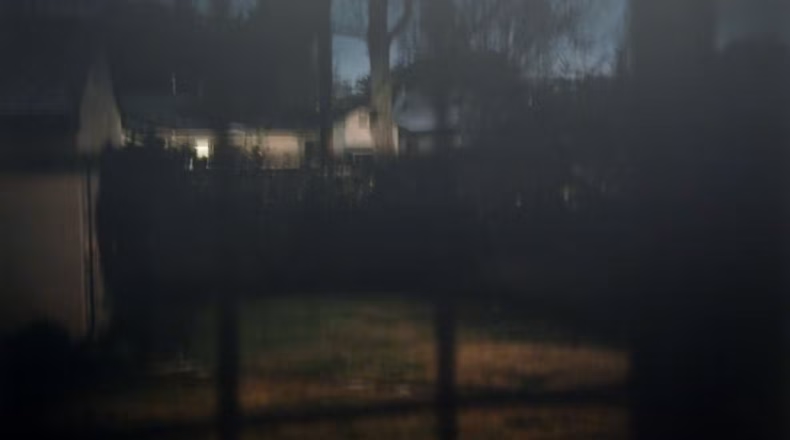
bluetreeblue5There was the moon, rising behind a tree.

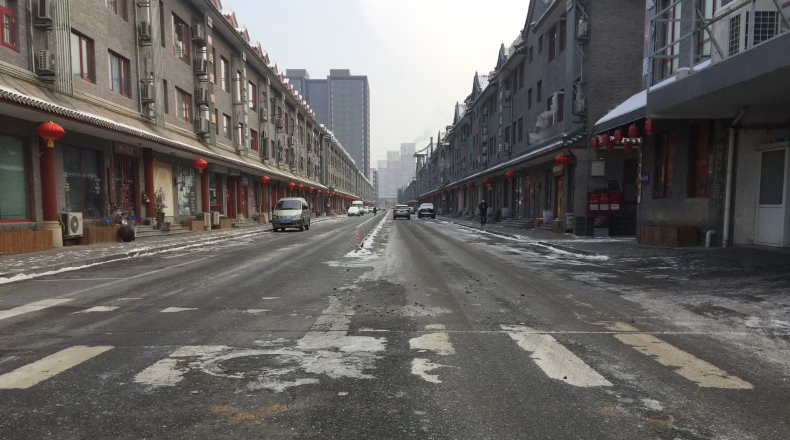
contributorsThe contributors list at Big Other recently changed and I’m wondering what the new organizing logic is. Before, the list recorded the order in which contributors joined the site. Now it’s something else. At first glance I thought it was now in alphabetical order, but it isn’t. Perhaps it’s arbitrary? But the names seem grouped according to initial letter: A D Jameson, Amber Sparks. But even that doesn’t work, because the list starts and ends with A’s. And not all the J’s are together, and later on there’s a P, then an N, then two P’s. Next I thought that it might be in order of total page views, but then Greg Gerke’s name would be higher up. It’s also not in order of who’s made the most recent post, because it isn’t, and if so it would always be changing. And that would also be redundant, since the posts themselves establish that order. So I just don’t get the list’s logic; I’m hoping this post provokes discussion of this issue, though I’ll concede it isn’t important. But I don’t like things I don’t understand, though I’ll also concede that there’s no real reason why I should understand anything. I’ll also admit that I haven’t been posting much as of late. I’ve been busy with school, but also been trying to figure out what I should post here. Below you can see a photo that I posted; I’ve long thought that it might be cool for this site to have more visual art. I spent most of last year posting links to movies, so I thought I might spend this year posting photos. But Edward is kinda already covering that with his Bluets posts. So I’m left wondering what the new list’s logic is, and what I should post. Perhaps I’ll put up posts like this, metatextual musings on the subject of Big Other? Well, I’ll first wait and see if anyone responds to this post. Thank you for reading.

Follow

Get every new post delivered to your Inbox.

Join 730 other followers